| | | | |

If You Ask People to Gather, It Better Be “Freaking Great”.

The 2026 World Cup has not yet begun, and already one of its stories is about what it costs to be there. Reuters reported that the attorneys general of New York and New Jersey subpoenaed FIFA over ticketing practices for matches at MetLife Stadium, including concerns about seat categories, high prices, and dynamic pricing. The Guardian described allegations around manipulated scarcity and fans being misled about what they were buying. FIFA has reported extraordinary demand, which is not surprising. The World Cup is one of the few truly global shared moments we still have.

The easy version of this story is about ticket prices. That is real, and it matters. But the deeper story is about the cost of presence. To attend something meaningful, people often spend far more than the ticket price. They spend time, planning, attention, anticipation, travel, childcare, vacation days, emotional energy, and sometimes a very real portion of their hope. They rearrange their lives around a moment that has not happened yet because they believe it might matter.

That is true for a World Cup final, but it is also true at smaller scales. A parent goes to a graduation. An employee flies to a sales kickoff. A customer comes to an advisory council. A volunteer gives up a weekend. A fan saves for a concert. A member travels to a conference. A community shows up for a public meeting. Each person pays in a currency that is partly visible and partly hidden. The visible part is the fare, fee, badge, hotel, or ticket. The hidden part is what else they could have been doing with that piece of their life.

This is the ethical layer of gathering. Once you ask people to come, you have accepted more than a logistical obligation. You have accepted a human obligation. You owe them clarity. You owe them safety. You owe them welcome. You owe them evidence that the experience was designed with their presence in mind. You owe them enough purpose that the trip does not feel like a trick and enough care that the room does not feel indifferent to the sacrifice it required.

That may sound strong, but I think it is increasingly necessary. We live in a world where nearly everything competes for attention. Travel is harder. Time feels thinner. Public trust is fragile. Prices are higher. People are more alert to being extracted from, monetized, or moved through systems that treat their emotion as demand. When someone chooses to show up anyway, that choice deserves reverence.

Scarcity complicates this. Scarcity can make an experience feel more valuable because it reminds people that the moment is finite. Not everyone can be in the room. Not every game, concert, meeting, dinner, or ceremony can be repeated. But scarcity becomes corrosive when it is used to create anxiety rather than meaning, when it makes people feel manipulated rather than invited. The difference is not subtle to the people on the receiving end. They can feel whether scarcity is part of the significance or part of the squeeze.

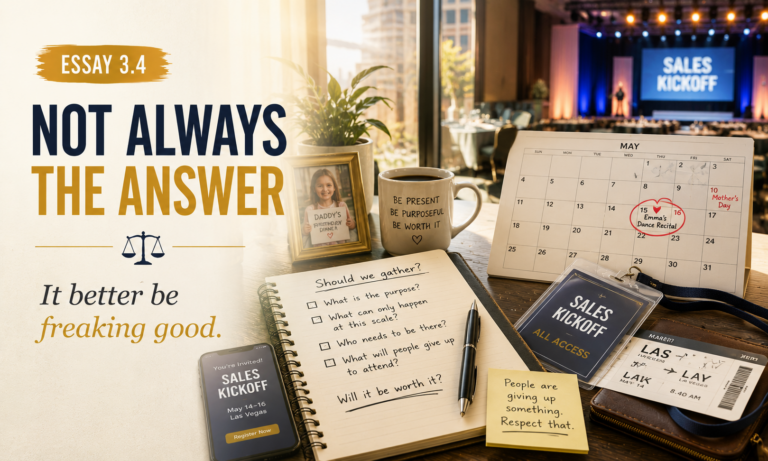
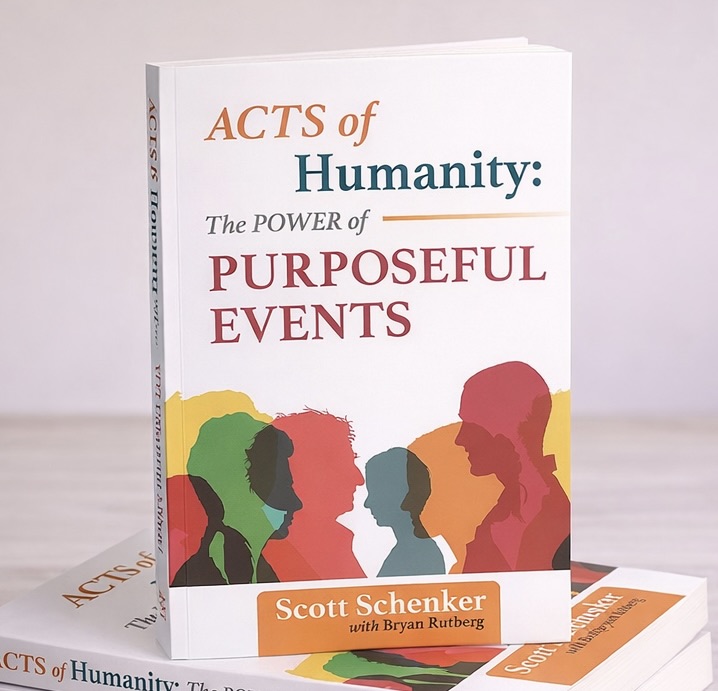
While writing Acts of Humanity: The Power of Purposeful Events, I interviewed David Schneider, a senior sales leader who said something every organizer should keep taped to the wall. He talked about missing his daughter’s birthday for a sales kickoff and losing time around Mother’s Day because of other work travel. Then he said, simply,

“So it better be freaking good.”

That line is funny, but it is not a joke. It is a moral test. Attendance costs more than airfare and hotel. People trade pieces of their lives to be present.

That is the heart. The head follows quickly. If the gathering is not worth the cost, resentment grows. If the purpose is unclear, people feel used. If the experience is careless, they remember the carelessness. If the organizers confuse attendance with commitment, they may get a full room and still lose trust. This applies to a global sporting event, a corporate meeting, an association conference, a fundraiser, a school night, or a family celebration. The scale changes. The obligation does not.

The hands are straightforward but demanding. Before asking people to gather, ask what they are really being asked to spend. Ask what they will miss in order to be there. Ask what fear or confusion might accompany them. Ask what relationship, memory, learning, decision, courage, or belonging can only happen because these people are together in this moment. If there is no honest answer, reconsider the ask. If there is an answer, design around it.

The point is not that every gathering must be grand. Some of the most meaningful gatherings are small and simple. The point is that every gathering must be worthy of the lives it interrupts. That is true whether someone is trying to secure a World Cup ticket, board a plane for a corporate kickoff, or walk into a room where they hope to feel included. When we ask people to gather, we are asking for something precious. So, it better be freaking good.
 

Source notes for verification
Reuters — New York and New Jersey probe FIFA World Cup ticketing practices: https://www.reuters.com/sports/soccer/ny-nj-probe-fifas-ticketing-practices-state-officials-say-2026-05-27/
The Guardian — New York and New Jersey subpoena FIFA over World Cup ticketing: https://www.theguardian.com/football/2026/may/27/new-york-new-jersey-investigation-fifa-ticketing


Similar Posts

Leave a Reply

Your email address will not be published. Required fields are marked *