| |

The More Digital Life Becomes, the More Human Gathering Matters.

At the same time everyone is talking about artificial intelligence replacing, accelerating, summarizing, generating, automating, or reshaping knowledge work, a global business-events company is being sold for about $1.8 billion.

That is worth sitting with for a moment. The Financial Times reported that Hyve, a major organizer of business events, is being sold to Hellman & Friedman in a deal that reflects renewed demand for face-to-face business gatherings in a world of hybrid work and AI disruption. On one level, it is a private-equity story. On another, it is a very human signal. At the exact moment information is becoming easier to generate and distribute, the places where people come together physically may be becoming more valuable, not less.

This seems contradictory only if we think gatherings are primarily about information. If the point of a conference, meeting, summit, council, or industry event is simply to deliver content, then digital tools should win. They are cheaper, faster, easier to scale, easier to search, easier to summarize, and increasingly able to personalize. A machine can produce a transcript, a deck, a recap, a recommendation, a meeting summary, a follow-up note, and a dozen variations of the same idea before anyone has found the ballroom coffee.

But that was never the whole point. Information is often the declared reason people gather. It is rarely the only reason they come, and it is almost never the reason they remember.

People gather to read the room. They gather to decide whom to trust. They gather to understand whether a leader believes what they are saying. They gather to meet the person behind the title, the company behind the booth, the colleague behind the email, the customer behind the account, the community behind the logo. They gather for the hallway, the meal, the glance, the interruption, the question after the session, the conversation that was not on the agenda but becomes the reason the trip mattered.

AI can help with a remarkable number of things. It can organize information, detect patterns, draft language, simulate options, summarize a meeting, and make many forms of communication more efficient. I use it. Most of us will. But efficiency is not the same as meaning. Summarization is not the same as trust. Personalization is not the same as being known. A synthetic conversation is not the same as the risk and reward of encountering another human being with all their uncertainty, body language, hesitation, humor, warmth, and complexity.

This does not mean in-person gatherings are automatically better. Bad events will not be saved by chairs and carpet. A room full of people can still be dull, manipulative, performative, or exhausting. The old mistake was assuming that if people were physically together, something important would happen. The new mistake would be assuming that because digital tools can carry information, nothing important requires physical presence.

The real question is what kind of work belongs to each mode. If digital tools can carry more of the information load, then human gatherings need to become more honest about the human work they are supposed to do. Do not bring people together to read slides at them. Bring them together when trust needs to deepen, when ambiguity needs to be worked through, when identity needs to be reinforced, when belonging needs to be felt, when conflict needs to be held, when a story needs to become shared, when people need to move from knowing something to caring enough to act.

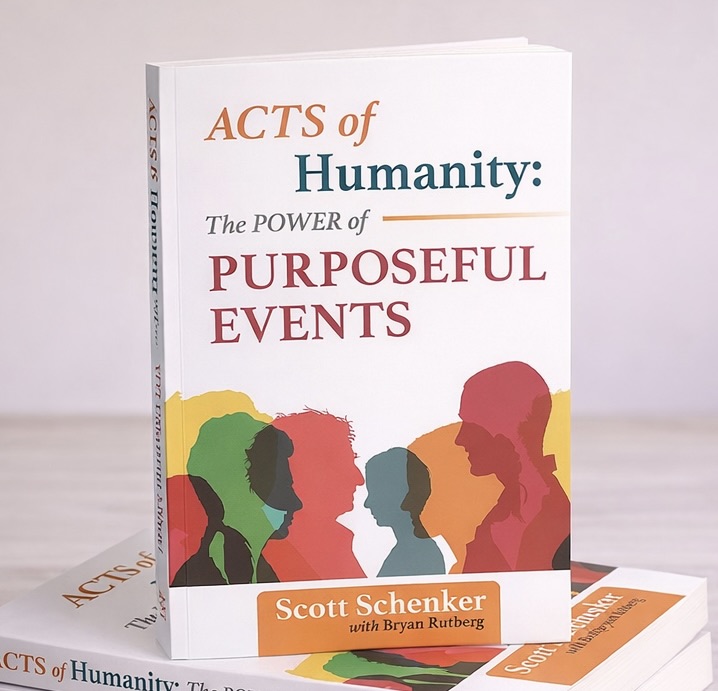
In Acts of Humanity: The Power of Purposeful Events, I wrote that digital communication is ubiquitous, which makes live events a rarer chance for face-to-face, multisensory engagement. That line feels even more true now. The point is not nostalgia for the pre-digital world. The point is discernment. When every interaction can become a link, a prompt, a feed, a stream, a transcript, or a summary, the moments that ask us to be fully present with one another must do different work.

That is why the Hyve story matters beyond the event industry. It suggests that as more of life becomes digitally mediated, the human layer may become more valuable. Not because humans are efficient. Often we are not. Not because rooms are magic. They are not. But because trust, memory, commitment, belonging, and shared meaning still seem to require something more than transmission.

The practical implication is simple and difficult. Make digital excellent at what digital does well. Then make gathering worthy of what only gathering can do. If people are going to leave their homes, board planes, navigate rooms, and give you their embodied attention, do not waste that gift on information they could have received alone. Use the room for the things that require people to be human together.


Source notes for verification
Financial Times — Events group Hyve sold to private equity firm Hellman & Friedman for $1.8bn: https://www.ft.com/content/c6c9d713-b05d-4d86-a16a-ed1fd002adba
The Times — Private equity firms sell Hyve for £1.3bn: https://www.thetimes.com/business/companies-markets/article/private-equity-group-sells-hyve-for-13bn-tripling-money-events-chd5cwgwq


Similar Posts

Leave a Reply

Your email address will not be published. Required fields are marked *