
| | |

Belonging Does Not Happen Just Because People Are in the Same Room.

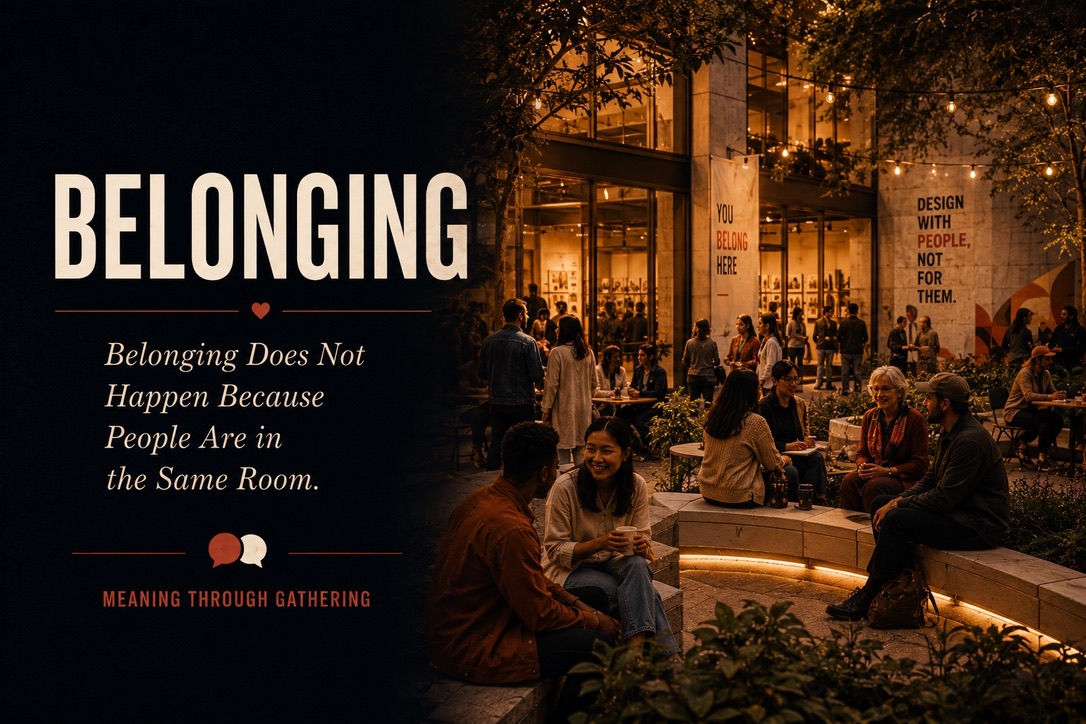
The London Festival of Architecture chose a deceptively simple word for its 2026 theme: belonging. Not skyline. Not innovation. Not resilience. Not density, sustainability, mobility, or growth. Belonging.

That choice matters because architecture is one of the places where abstract human needs become concrete. A doorway can invite or intimidate. A plaza can linger or repel. A neighborhood can feel porous or guarded. A school can say, in a hundred small ways, that children are expected, or that they are being managed. A city can make people feel rooted, recognized, and included, or it can remind them that they are passing through someone else’s place.

Wallpaper’s coverage of the festival describes belonging as a question of ownership, identity, inclusivity, memory, and urban space. One member of the festival’s curation panel described belonging as the moment when a street, scent, or skyline becomes part of your story. That phrase stayed with me because it shifts belonging away from the administrative language of access and into the emotional language of recognition. It is one thing to be allowed in. It is another thing to feel that the place has made room for you and your story.

Most of us know this feeling immediately, even if we do not always name it. We know the restaurant where we can exhale. We know the school hallway that made us shrink. We know the neighborhood where we felt visible in a good way and the room where we felt overexposed. We know the office where newcomers are folded in and the office where they are left to decode the culture alone. We know the gathering where we felt expected, and we know the gathering where we technically belonged but emotionally did not.

That distinction is important. Belonging is not the same thing as attendance. It is not the same thing as registration, membership, citizenship, employment, admission, or invitation. Those can get you through the door. They do not necessarily tell your nervous system that you are safe, seen, wanted, or understood. Belonging is often built through signals so small that the host may barely notice them: how arrival works, who greets whom, whether language is explained, whether insiders make room, whether newcomers are helped before they have to ask, whether the setting quietly says, “we thought about you before you got here.”

This is why the architecture story belongs in a larger conversation about meaning. Humans do not find meaning in the abstract. We find it somewhere, with someone, through something. Place matters because place holds memory. It gives relationship a setting. It gives ritual a home. It gives identity material to work with. A kitchen table, a front porch, a temple, a stadium, a local pub, a college quad, a city square, a synagogue, a library, a workshop, a convention hall — each can become part of the story people tell about who they are and where they belong.

The danger is assuming that belonging will happen just because people are proximate. It does not. A crowd can be lonely. A meeting can be alienating. A beautifully designed space can feel like it was made for someone else. A perfectly executed event can still leave people thinking, “I was there, but it was never really for me.” That is one of the hardest truths for anyone who convenes people. We often measure whether people arrived. We are less disciplined about whether they felt received.

In Acts of Humanity: The Power of Purposeful Events, I wrote about hosting as the work of helping people cross a threshold and feel expected. One of the lines I keep returning to comes from a personal story about my mother arranging a visit for a small group:

“A group of people going somewhere is not the same as a group of people being received.”

That sentence has become, for me, one of the simplest tests of gathering design. Did people arrive, or were they received? Did they attend, or did they begin to belong?

The London Festival of Architecture’s theme is useful because it reminds us that belonging is designed long before anyone writes a registration confirmation or prints a badge. It is designed in the shape of spaces, the rituals of welcome, the vocabulary of insiders, the care for outsiders, and the courage to ask who has not yet felt that the place includes them. The same is true of events and experiences. They are temporary places. They do not last as long as buildings, but while they exist, they still tell people who matters, who is expected, who has agency, and who is merely being processed.

So, the practical question is not simply how do we bring people together. It is how do we help them belong once they arrive. What will make the place personal? What will help their narrative align with the shared life of the room? What will allow someone to leave thinking not just “I went,” but “there was a place for me there?” That is where gathering begins to become an act of meaning rather than an exercise in logistics.


Source notes for verification
Wallpaper — London Festival of Architecture 2026 guide: https://www.wallpaper.com/architecture/architecture-events/london-festival-of-architecture-2026-guide
Wallpaper — LFA 2026 theme is revealed: https://www.wallpaper.com/architecture/belonging-lfa-2026-theme-london-uk
Wallpaper — LFA 2026 wants you to take part: https://www.wallpaper.com/architecture/lfa-2026-rosa-rogina-activities


Similar Posts

Leave a Reply

Your email address will not be published. Required fields are marked *